
.png)
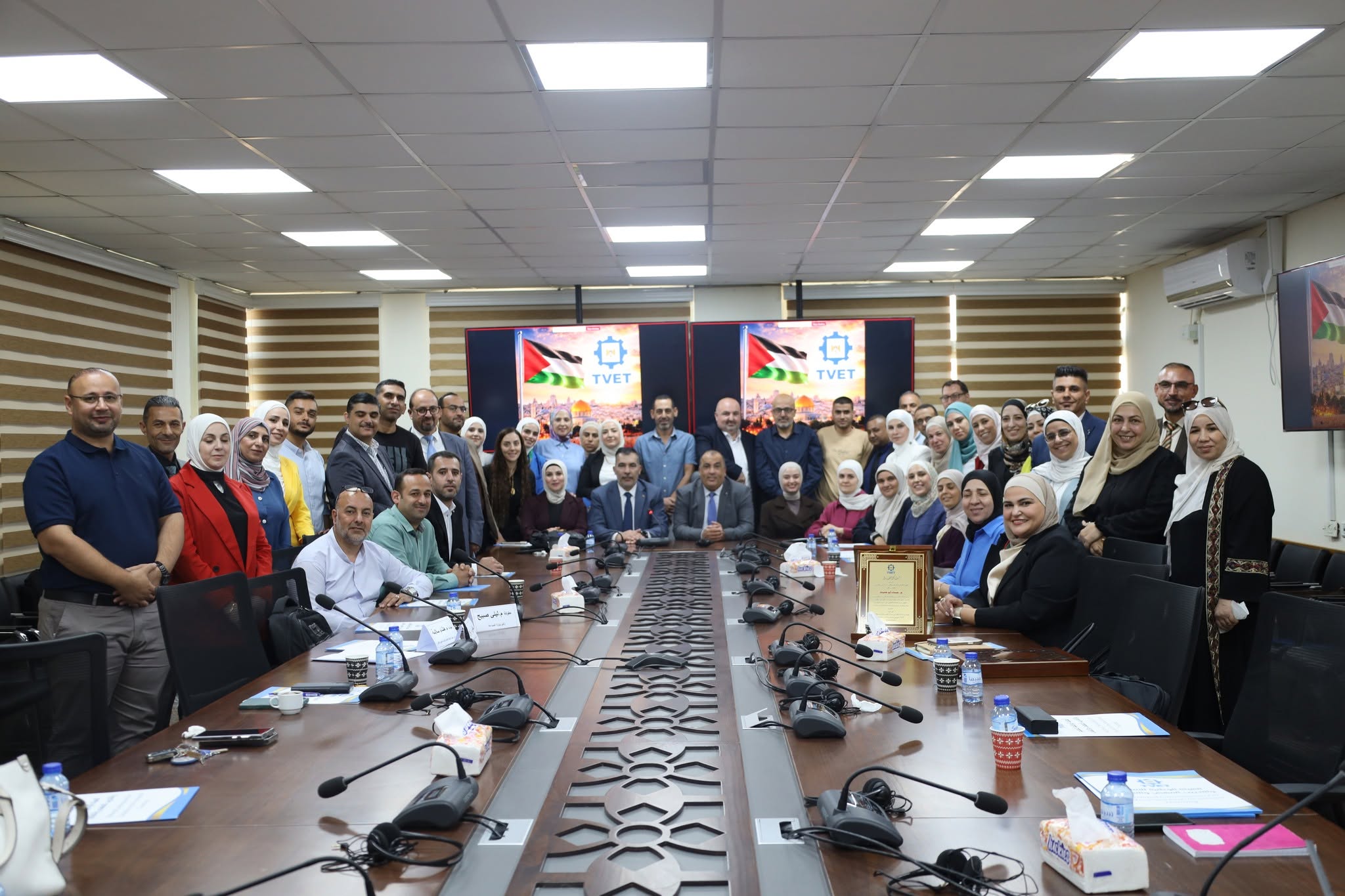
NTC Concludes Training Program for TVET Leaders in Palestine
Ramallah, 6 September 2026
The National TVET Commission (NTC) concluded the Entrecote Training Program for Technical and Vocational Education and Training (TVET) Leaders in Palestine, aimed at strengthening the entrepreneurial and innovative capacities of professionals working across the sector and enabling them to develop practical solutions that respond to labor market challenges and needs.
The closing ceremony was held on Sunday at the NTC headquarters in Ramallah.
The program was organized by the NTC within the framework of the VET Social Impact Project, funded by the Erasmus+ Program and implemented in coordination with VIS. Around 120 participants took part in the program, which sought to empower TVET leaders and professionals to apply practical tools and methodologies for institutional development, strengthen entrepreneurial and innovative thinking, build strategic and institutional capacities, and develop innovative solutions to challenges facing TVET institutions.
NTC President Dr. Rabah Marar said that the Commission, as the national umbrella and policy-making body for the TVET system, is working to broaden the horizons of technical and vocational education and training and develop a new generation of leaders in the sector.
“This is only the beginning,” Marar said, noting that the NTC plans to implement additional activities and programs aimed at strengthening competencies and supporting the various components of the Palestinian TVET system.
Marar stressed that investing in the capacities of leaders and professionals working in the sector is a fundamental pillar of institutional development. He highlighted the importance of moving beyond traditional training approaches toward empowering TVET professionals with entrepreneurial and innovative thinking tools that enable them to transform institutional challenges into opportunities for development and continuous improvement.
He added that promoting a culture of innovation and entrepreneurship would strengthen the sector’s ability to respond to changes in the labour market and support the development of programs and services that are more closely aligned with the needs of learners and employers.
Marar also emphasized the importance of expanding partnerships among TVET institutions, the private sector, government bodies and local communities in order to build a more flexible, sustainable and responsive TVET system capable of generating meaningful development impact.
For her part, Laila Sbeih, Undersecretary of the Ministry of Industry, said that building capacities and investing in training are among the government’s priorities, as they constitute a fundamental building block for human development and sustainable development.
Sbeih noted that the closing ceremony marks the beginning of a series of future programmes that will address different areas of the Palestinian economy.
Participating remotely from Italy, Emanuela, Project Coordinator and representative of VIS, expressed her deep appreciation for the NTC, its leadership and its team, commending the high level of cooperation and commitment demonstrated throughout the implementation of the project.
She highlighted VIS’s longstanding relationship with Palestine and reaffirmed the organization’s continued commitment to working alongside the Palestinian people and supporting youth, TVET, and economic and social development.
Emanuela praised the achievements of the participants, stressing that the true value of the program goes beyond the delivery of training. Its greater value lies in enabling participants to translate what they have learned into practical ideas and initiatives capable of creating economic and social value.
She emphasized that the closing ceremony does not mark the end of the journey, but rather represents a new milestone in a partnership that VIS looks forward to continuing and further developing with the NTC in the coming period.
NTC President Dr. Rabah Marar expressed his appreciation for the partnership with VIS and extended special thanks to Emanuela for her cooperation, commitment and continuous follow-up. He stressed that the NTC considers VIS an important partner in advancing TVET, promoting entrepreneurship and innovation, and developing skills in Palestine.
NTC Deputy Chairman Dr. Eng. Hisham Salama also expressed the Commission’s appreciation to Emanuela, the VIS team and all project partners for their cooperation and continued support for the Palestinian people.
He stressed the importance of building on the program’s achievements and moving from training to application, and from ideas to scalable and sustainable projects and initiatives.
Salama explained that a number of projects had been submitted in April, from which the five best projects were selected. The winning projects reflected a diverse range of innovative, technological and entrepreneurial approaches.
The five selected projects were:
• “Takween – National Platform for Smart Manufacturing and Productive Innovation,” supervised by Imad Al-Qasem from An-Najah National University, Faculty of Engineering.
• “Artificial Digital Media Innovation Ecosystem – Smart Digital Media and Content Creation Centre,” supervised by Ali Erekat from Al-Quds University, Professional College in Jerusalem.
• “Development of the Vocational Education Centre in Tulkarm,” supervised by Maysaa Abu Ajina, in partnership with the Tulkarm Chamber of Commerce and Industry and Palestine Technical University – Kadoorie.
• “Development of an Automotive Mechatronics Workshop for Hybrid and Electric Vehicles,” supervised by Ahmad Rashid Al-Aham.
• “Green Shield – Digital and Energy Sovereignty Platform / National Centre for Energy Security and IoT Infrastructure,” supervised by Samira Abu Ghalyoun and Raafat Al-Junaidi from Palestine Polytechnic University.
Participant Samira Abu Ghalyoun said that taking part in the program was not simply a training course, but rather a comprehensive experience that enriched participants’ knowledge of entrepreneurship and training, broadened their perspectives, and created a valuable space for exchanging experiences and interacting with peers.
She noted that participants had witnessed growing attention to technical and vocational education and training, with increased emphasis on capacity building and the implementation of high-quality program and activities.
She added that the NTC’s presence has become increasingly visible across events, conferences, universities and educational institutions, reflecting the growing recognition of TVET as an integral component of Palestine’s development, economy and labor market.
Joining the ceremony remotely from the Gaza Strip, participant Jamalat Abu Hamada said that their participation carried a meaning far beyond receiving a certificate or completing a training program.
“Being here today represents a challenge and an achievement for us, particularly under the extremely difficult circumstances we are facing,” she said.
She added that the program provided participants with an opportunity to learn, strengthen their entrepreneurial skills and move from ideas and vision toward initiative and implementation.
Abu Hamada expressed the participants’ aspiration to continue developing their capacities and contribute to building a TVET system that is increasingly responsive to labor market needs.
At the conclusion of the ceremony, certificates of completion were presented to the participants, while the owners of the five winning projects and project partners were recognized for their contributions to the successful implementation of the program and their support for capacity-building efforts within the Palestinian TVET sector